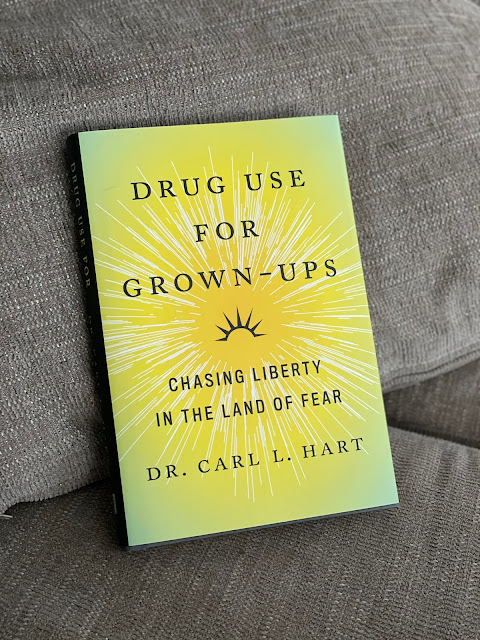
Hart recognizes how drugs may have been criminalized in the United States to specifically target minorities. One such example is the difference in sentencing between crack and cocaine, which are essentially the same drug. Hart is working to expose racism embedded in drug laws and to decriminalize drug use through policies that are scientifically based rather than heavily influenced by social determinants of the era., Hart has lectured in Africa, Asia, Europe, and North and South America and has testified before the United States Congress and around the world as an expert witness on psychoactive drugs.
He also uses the intersection of his understanding about the systemic racism inherent in drug criminalization, in combination with his extensive knowledge about drugs, to combat mainstream stories which perpetuate myths of black (and other minority) inferiority. One such example was a response to the Toxicology report presented in the case of Trayvon Martin. The extremely low levels of marijuana in Martin's blood were seen as evidence that he might have been paranoid the night of his shooting, causing him to attack Zimmerman. Hart spoke out about this ruling—explaining that it ascribed to old notions of marijuana use, such as those implied in Reefer Madness, and failed to recognize the seven decades of research on marijuana that would 1) show the levels of marijuana present in Martin's blood were insufficient to cause the aforementioned side effects, and 2) disavow the side effects mentioned which are extremely uncommon in marijuana users.
Hart calls for the use of empirical research in determining drug-related incidents across greatly varying scenarios, with the hope that scientifically grounded research will trump the racist policies currently in place, and decrease the unjust incarceration and punishment of black communities for drug use.
In May 2017, Hart was invited to speak at a drug policy forum conference held at the University of the Philippines Diliman. In his speech, he addressed the misconceptions about methamphetamine in the Philippines amidst President Rodrigo Duterte's war on drugs. Citing laboratory tests on animals, Hart refuted Duterte's claim that methamphetamine shrinks people's brains and causes them to become violent. In the aftermath of his speech, Hart began to receive online death threats which forced him to leave the Philippines shortly thereafter. Duterte commented on Hart's claims, saying: "That's all bullshit to me". Duterte also called Hart a "son of a bitch who has gone crazy". In an interview with Public Radio International, Hart described Duterte as "a president making such ignorant comments about drugs — like he’s a pharmacologist" and added that Duterte was "out of his league when he talks about drugs".
In 2021, Hart appeared in the Netflix documentary Crack: Cocaine, Corruption & Conspiracy where he talked about the complex history of crack in the 1980s.
Drug Use for Grown-Ups
https://www.theguardian.com/society/2021/feb/06/meet-carl-hart-parent-columbia-professor-and-heroin-user
Behind him in his office is a photograph of Malcolm X. Among many other things, Hart’s book is an examination of the racism and scaremongering that have long underpinned drug legislation in the US, leading to a system that disproportionately punishes black drug users. While most crack users in the 1990s were white, 90% of those sentenced under harsh anti-crack laws were black.
African Americans remain far more likely to be incarcerated for drug crimes than white Americans. And they are four times more likely to be arrested for marijuana possession than their white counterparts. In the UK, while the inequality is not so extreme, racial bias in sentencing still exists. Last week, it was reported that black drug dealers are 1.4 times more likely to be handed immediate custodial sentences than white people convicted of similar crimes.
Hart displays the passion of the convert in attacking misconceptions of African American drug use, because, as he confesses in the book, he once “wholeheartedly believed that drugs destroyed certain black communities”.
It was visiting white friends in pleasant neighbourhoods who were engaging in the same drug use he believed led to community dysfunction that made him realise it wasn’t the drugs but the context in which they were taken that harmed people. All the same, he says it took him a long time to acknowledge to himself what his scientific research and personal experience were telling him. So why did he resist for many years the logic of his own findings on drugs such as heroin?
“It wasn’t that I was opposed to it,” he explains. “It was that I was incentivised to find a certain thing. And when you are incentivised to find a certain thing, you are blinded. I needed to keep my lab running. I needed to support these salaries. I didn’t have to defend my position as strongly as I do now – I always have to be thinking about the other position. Whereas as long as you toe the party line you don’t have to think about that. You have all of this support and machinery built up to prop up that perspective.”
One Neuroscientist Rethinks Addiction
https://drcarlhart.com/one-neuroscientist-rethinks-addiction/
“Drugs are not as dangerous as we have made them out to be,” Hart says. “I’m trying to get people to use the data, the empirical evidence, and when you do that, you realize that we have been lied to, the public has been lied to.”
Professor Hart has been taking the stand and submitting written testimony in family courtrooms around the city, advocating for children to stay with their parents, even if their parents have tested positive for using marijuana.
Hart says the belief that casual marijuana use impairs your parenting has no scientific basis — and pot use that isn’t excessive is on par with having a drink now and again: “We don’t remove children because their parents drink alcohol,” Hart points out. “My kids would be removed if that was the case.”
#FB00241