Showing posts with label medicine. Show all posts

Sunday, February 12, 2023

Ingrown hair removal

Ingrown hairs can look like raised, itchy bumps on the skin.

On white skin the bumps may look red. Redness may be harder to see on black or brown skin, but they may look a different color to the surrounding skin.

Sometimes one can see a hair trapped under the skin.

One is more likely to have ingrown hairs if one has coarse or curly hair.
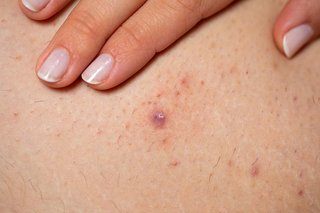
Close up of a small, round, red bump where a hair has grown into the skin, shown on white skin.

Infected ingrown hairs can be painful.  Pus may also be seen.

Waxing, plucking and threading hair can also lead to ingrown hairs. Areas most common for ingrown hair include: the face and neck, legs, armpits, chest, back, pubic region.

The best way to prevent ingrown hairs is by not shaving.

If one wishes to shave, or remove hair in another way, there are things to do to prevent ingrown hairs and help them get better quicker.

Do

  • wet your skin with warm water and use shaving gel

  • shave in the direction the hairs are growing

  • use as few strokes of the razor as possible

  • rinse the razor after every stroke

  • hold a cool, wet cloth to your skin after shaving to reduce irritation

  • use an exfoliating scrub to help release any trapped hairs

  • try a different hair removal method, such as hair removal cream

  • try a long-term way of removing hair, such as laser treatment

Don’t

  • do not shave too close – leaving some stubble can stop bacteria getting in

  • do not use a blunt razor

  • shave every other day if possible

  • do not scratch, pick or squeeze ingrown hairs as this can damage your skin and lead to infection

A pharmacist can help with ingrown hairs

  • creams and lotions to help itching
  • shaving and hair removal products to help prevent irritation
  • exfoliating products to help prevent ingrown hairs
  • a mild antiseptic to help prevent infection

When to see a doctor

If the area around an ingrown hair is very painful, hot or swollen. Also, it one has a high temperature, feels hot, shivery and generally unwell. 


 #FB00806

Wednesday, November 30, 2022

Excited Delirium Syndrome

The term "excited delirium" (ExDS) was first used in a 1985 Journal of Forensic Sciences article, co-authored by deputy chief medical examiner for Dade County, Florida. Charles Victor Wetli (1943—2020), entitled Cocaine-induced psychosis and sudden death in recreational cocaine users. The JFS article reported that in "five of the seven" cases they studied, deaths occurred while in police custody. Wetli determined that nineteen women, all Black prostitutes, had died of the condition due to "sexual excitement" while under the influence of cocaine. In 1992, police announced they had found a serial killer responsible for deaths determined by Wetli to be excited delirium. The legitimacy of the condition has since been under controversy with most of the medical community not recognizing it, and there is no official entry for it in the official Diagnostic and Statistical Manual of Medical Disorders.


The supposed risk factors vary including "bizarre behavior generating phone calls to police", "failure to respond to police presence", and "continued struggle despite restraint". It supposedly endows individuals with "superhuman strength" and being "impervious to pain." 

In 1849, a superficially similar condition was described by Luther Bell as "Bell's mania". Bell was one of thirteen other mental hospital superintendents who met in Philadelphia in 1844 to organize the Association of Medical Superintendents of American Institutions for the Insane (AMSAII), now the American Psychiatric Association.

Excited delirium (ExDS), also known as agitated delirium (AgDS), is a controversial diagnosis sometimes characterized as a potentially fatal state of extreme agitation and delirium. It is typically diagnosed postmortem in young adult males, disproportionally Black men, who were physically restrained at the time of death, most often by law enforcement personnel. Symptoms are said to include aggressive behavior, extreme physical strength and hyperthermia.

#FB00717

Thursday, July 1, 2021

Friday, April 9, 2021

Alpha-gal syndrome

Amblyomma americanum, a vector for the allergy


I met someone today with Alpha-gal syndrome. He was an Eagle Scout and probably got bit by a tick while outdoors. He was one of the first people in the state of Missouri "officially" diagnosed with the condition.

Alpha-gal syndrome is a type of food allergy to red meat and other products made from mammals. In the United States, the condition most often begins when a Lone Star tick bites someone. The bite transmits a sugar molecule called alpha-gal into the person's body. In some people, this triggers an immune system reaction that later produces mild to severe allergic reactions to red meat, such as beef, pork or lamb, or other mammal products.

The Lone Star tick is found predominantly in the southeastern United States, and most cases of alpha-gal syndrome occur in this region. The tick can also be found in the eastern and south central United States. The condition appears to be spreading farther north and west, however, as deer carry the Lone Star tick to new parts of the United States. Alpha-gal syndrome also has been diagnosed in Europe, Australia and Asia, where other types of ticks carry alpha-gal molecules.

Researchers now believe that some people who have frequent, unexplained anaphylactic reactions — and who test negative for other food allergies — may be affected by alpha-gal syndrome. There's no treatment other than avoiding red meat and other products made from mammals.

Read more here.

#FB00341

Monday, December 14, 2020

Uncombable hair syndrome

Wynter Seymour, 7, from Northallerton, England, has uncombable hair syndrome, which is thought to affect only 100 people worldwide.

Uncombable hair syndrome is a condition that is characterized by dry, frizzy hair that cannot be combed flat. This condition develops in childhood, often between infancy and age 3, but can appear as late as age 12. Affected children have light-colored hair, described as blond or silvery with a glistening sheen. The hair does not grow downward but out from the scalp in multiple directions. Despite its appearance, the hair is not fragile or brittle, and it grows at a normal or slightly slower rate. Only scalp hair is affected in uncombable hair syndrome.

For unknown reasons, this condition usually improves over time. By adolescence individuals with uncombable hair syndrome have hair that lies flat and has normal or nearly normal texture.

There are only about 100 people worldwide with UHS.

It's believed that Albert Einstein had this condition. (Not everyone with this syndrome has hair that returns to a "normal" state of growth after adolescence.)

Albert Einstein

Read more here.

#FB00184

Saturday, November 14, 2020

Misc videos

https://www.youtube.com/shorts/f4wwIULWuOQ https://www.youtube.com/shorts/-Zjs9qT9xmY I don't know why I am having trouble with posting ...
